No contractFree trial classNew beginners-only class Tuesdays 6pmSelf-defenceGroundStrikingThrows and TakedownsPart of 45+ Year TJK associationNo contractFree trial classNew beginners-only class Tuesdays 6pmSelf-defenceGroundStrikingThrows and TakedownsPart of 45+ Year TJK associationNo contractFree trial classNew beginners-only class Tuesdays 6pmSelf-defenceGroundStrikingThrows and TakedownsPart of 45+ Year TJK associationNo contractFree trial classNew beginners-only class Tuesdays 6pmSelf-defenceGroundStrikingThrows and TakedownsPart of 45+ Year TJK associationNo contractFree trial classNew beginners-only class Tuesdays 6pmSelf-defenceGroundStrikingThrows and TakedownsPart of 45+ Year TJK associationNo contractFree trial classNew beginners-only class Tuesdays 6pmSelf-defenceGroundStrikingThrows and TakedownsPart of 45+ Year TJK association
Choosing a club

Which martial art is
actually best for
self-defence?

The honest answer is that the style on the sign matters less than four things you can check for yourself. Here they are, how the main options measure up, and the questions worth asking any club before you join.

There is no single
best martial art.

But some training transfers to a real situation far better than other training, and the difference is something you can actually check.

People usually ask this question expecting a league table. It doesn't exist. A good boxing gym will do more for your ability to handle yourself than a poorly run jujutsu club, and the reverse is just as true. The instructor and the training culture matter more than the name above the door.

What does hold up across every style is a small number of training characteristics. Clubs that have them produce people who can use what they've learned. Clubs that don't produce people who are very good at the dojo version and have never found out whether it works.

We teach Jujutsu in Tewkesbury, so we have an obvious interest in the answer. What follows is the honest version anyway, because you'll work it out within a month of joining anywhere and we'd rather you arrived with your eyes open.

Below: the four tests, what each of the main options is genuinely good at, where each one has a gap, and the questions worth asking before you hand over a membership fee. Including to us.

Four things that
actually predict it.

None of them is the style name. All four can be checked on a single visit.

01

All four ranges

Real confrontations do not stay where you would like them. They begin at talking distance, close quickly into a clinch, and frequently finish on the ground. Training that covers one range beautifully leaves you guessing in the other three — and you don't get to choose which one you end up in.

02

Live resistance

There is a wide gap between a technique that works on a cooperative partner and one that works on somebody actively stopping you. Sparring against genuine resistance is the only thing that tells you which one you have. If you take one test from this page, take this one.

03

The law and the exit

In the UK you are accountable for what you do. Reasonable force, when you can act, when to simply leave — a club that skips this is teaching half a skill, and the missing half is the one that keeps you out of a courtroom.

04

A sane progression

Nobody should be doing knife defence in week two. Graded material, where the difficulty tracks your actual level, is how people become competent rather than collecting techniques they cannot perform under any pressure at all.

How the options
measure up.

Broad strokes, and a good instructor beats every generalisation on this table. Use it to know what to ask, not to rule anything out.

Style
Strongest at
Worth checking
Krav Maga
Strongest atBuilt for self-defence from day one. Takes weapons, multiple attackers and acting early seriously, with no sport rules getting in the way.
Worth checkingThere is no single governing body, so standards differ sharply between schools. Ask how much sparring is done against a fully resisting partner, and how much ground work is in the syllabus.
BJJ (Modern)
Strongest atGround control and submissions, pressure-tested hard in almost every session. Excellent at the range most people are least prepared for.
Worth checkingVery little striking and almost nothing on the stand-up phase where incidents actually start. Sport scoring also rewards some positions you would not want on concrete.
Boxing & kickboxing
Strongest atStriking, distance and timing, trained under real pressure. Also the underrated experience of being hit and carrying on thinking.
Worth checkingOne range only. No answer to being grabbed, pushed against a wall, taken down, or held.
Judo
Strongest atThrows, grip fighting and takedown defence, all against full resistance from early on. Transfers well to a real clinch.
Worth checkingNo striking at all, and competition rules limit how far the ground work goes.
Karate & taekwondo
Strongest atStriking mechanics, distance management and a disciplined training culture. Widely available and usually well structured.
Worth checkingQuality varies enormously. Many clubs spar under point rules with light contact and do no grappling whatsoever.
MMA
Strongest atThe most complete pressure-tested skillset there is for a one-on-one unarmed fight. Covers every range and tests all of it.
Worth checkingBuilt around a rules-set and a fit opponent of roughly your size. Little on weapons, multiple attackers, awareness, de-escalation or the law.
jujutsu
Strongest atA broad technical syllabus — strikes, throws, locks, restraints and ground work in one system rather than four.
Worth checkingBreadth is only worth something if it is tested. Ask whether the club spars, or whether the syllabus is drilled cooperatively and never stressed.

Notice that the same question appears in the right-hand column over and over. Resistance is the thing. Everything else is a detail by comparison.

Where we fit

All four ranges.
One membership.

Most clubs are strong in one range and quiet about the rest. TJK teaches striking, throws and takedowns, ground work and practical self-defence as one graded syllabus — not as four separate things you would otherwise pay four gyms to learn.

  • Stand-up striking, blocks and distance
  • Judo-style throws and takedown defence
  • BJJ-style ground work, including getting back up
  • Restraints, control and weapon defence at senior grades
  • Awareness, de-escalation and UK law on reasonable force
Test two, in practice

Cooperative first.
Then it stops
being cooperative.

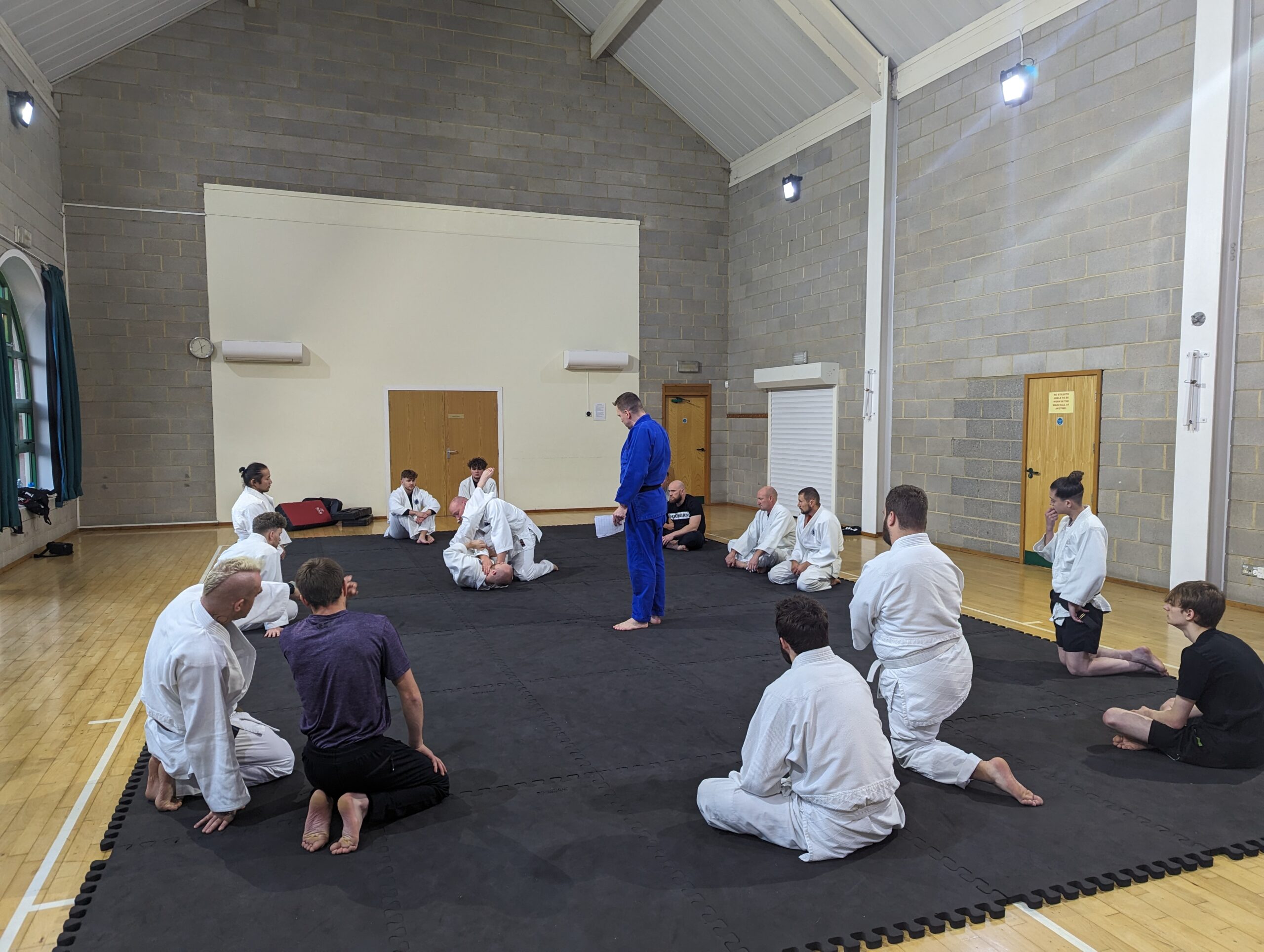
Every technique starts static, so you can learn the shape of it without fighting for it. Then the pace comes up. Then your partner stops helping. Then it goes into a scenario where you don't know what is coming.

That progression is why the sport side of the club matters even to members who will never compete. Sparring, randori and live rounds are not a separate hobby bolted onto the self-defence syllabus — they are the quality control on it. A technique that keeps working when somebody is genuinely resisting has earned its place. One that doesn't gets found out in the room rather than on a pavement.

It is also why beginners are taught separately at first and graded through a white belt syllabus over roughly ten sessions. Resistance is only useful once you have something to resist with.

How sport feeds self-defence
Test four, in practice

Graded, so nobody
runs before
they can walk.

The TJK syllabus has been built and revised over forty-five years, and it is deliberately ordered. Releases and escapes from grabs, holds and strangles come first, because they are by far the most likely thing anyone will need. Strikes and blocks, then throws and takedowns, then restraints and control, then ground defence.

Weapon and knife defence sits at senior grades and is taught honestly — what is realistic, what is not, and why distance and leaving come before anything else. A club that puts knife work in front of beginners is selling reassurance, not skill.

The white belt pathway

Who sets
our standard.

The association

Taijutsu Kai was founded in 1980 and now runs ten clubs across Worcestershire and Gloucestershire under one syllabus and one grading standard. Tewkesbury is not an independent club deciding its own belts — gradings are set and checked by the association, and its annual seminar in October 2025 brought nearly four hundred members together across five hours of training.

Hanshi Ross Iannoccaro

Head of the association and an 8th Dan in Jujutsu, also 2nd Dan in Judo and 1st Dan in Karate, training since 1972. He was the first non-Japanese martial artist awarded 7th dan and the title Tasshi by Fumon Tanaka Soke, and one of the first people in the UK taught Gracie Jiu-Jitsu directly by Master Carley Gracie. He created Grapple & Strike, one of Britain's earliest MMA events, and Combat magazine called him a UK pioneer of the sport in 2000.

Continuous development

The syllabus is not frozen. Senior instructors across the association run seminars and feed material back into it — among them Sensei Daniel Tamblyn, an experienced armed police officer, awarded his 5th Dan in 2025, who works directly with Hanshi Ross on syllabus development. Forty-five years in, the self-defence material is still being revised.

Common
questions.

The ones we get asked most often by people comparing clubs.

Is Krav Maga better than Jujutsu for self-defence?

Neither answer is true as a blanket statement, and anyone who gives you one confidently is selling something. A well-run Krav Maga club with real sparring will serve you better than a jujutsu club that never tests anything, and the reverse holds too. Compare the two specific clubs you could actually attend, using the four questions above, rather than the two styles in the abstract.

What's the best martial art for a complete beginner?

The one you will still be attending in six months. Consistency beats style selection by a distance — technique only becomes usable through repetition, and that requires turning up. Pick somewhere close enough to reach on a bad day, with people you don't mind spending two hours a week with.

Do I need to be fit before I start?

No. Beginners are taught separately from the main class and work at their own pace. Fitness comes from training rather than before it, and people join us specifically because a structured class is easier to stick to than a gym membership.

How long until I could actually defend myself?

Useful escapes from grabs and holds come within the first few months, because that material is taught first for exactly that reason. Genuine competence under pressure takes longer — a year or two of regular training. Any club promising more than that in a weekend is describing a certificate, not a skill.

Will I get hurt?

Training involves contact, so bumps and bruises happen. Serious injury does not, because intensity is matched to your level and partners are supervised. Nobody is thrown into hard sparring in week one, and resistance is introduced gradually and deliberately. Instructors are first aid trained and fully insured.

Is there women's-only training?

Yes. Sensei Gemma runs a ladies area on Sunday evenings alongside the main class, and women train in every session we run.

Your first
class is free.

Come and try a jujutsu class for yourself, for free!